
The inner silence and the outer dynamism
Florbela Caniceiro
Florbela Caniceiro from the Sri Chinmoy Centre in Coimbra, Portugal talks about what she loves about Sri Chinmoy's Path - the inner silence of meditation, and also how this inner silence can be combined with the outer dynamism of music and other activities.
Selfless Service
Brian David
Brian from Seattle talks about the meaning of selfless service and the spiritiual benefits of working without expectation.
Overcoming challenges on the spiritual path
Mirjana Bulj
Mirjana Bulj from Podogorica in Montenegro talks about some of the challenges faced on the spiritual life and how she overcame them. When Mirjana started following Sri Chinmoy's path, she found both running and singing very challenging. But, over time, she was able to make progress and get joy from running marathons and singing with others.
Coming to Sri Chinmoy's Path - Carlos
Carlos Machado
Carlos Machado talks about what drew him to Sri Chinmoy's Path. He explains how following the spiritual life changed his outlook on life and what he thinks is the essence of following a spiritual life.
New book: plays based on stories by Sri Chinmoy
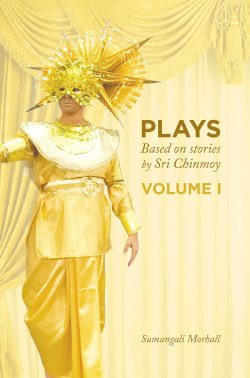 This month marks the release of a new book of ten plays by Sumangali Morhall, based on stories by Sri Chinmoy. Each play contains between one and thirteen stories, set to rhyming verse.
This volume has since been accepted by the library of Harvard Divinity School.
Sumangali comes from York, UK and this is her second book, her first being Auspicious Good Fortune, an account of how she came to the spiritual life.
In the introduction to the book, Sumangali explains how she began writing these plays:
"These rhyming plays began on a Christmas Trip with Sri Chinmoy in China, December 2004. On our winter retreats, as well as meditating with Sri Chinmoy in person, we had the privilege of immersing ourselves in his new creations: songs, prayers, aphorisms, stories and artwork. In the evenings it usually fell to us, his disciples, to entertain one another on stage. Much of the programme consisted of plays based on the Master’s stories – some of which are tales retold from Indian folklore, others anecdotes from Sri Chinmoy’s own experience, others born of his own creative imagination, and many seemingly from delightful worlds between.
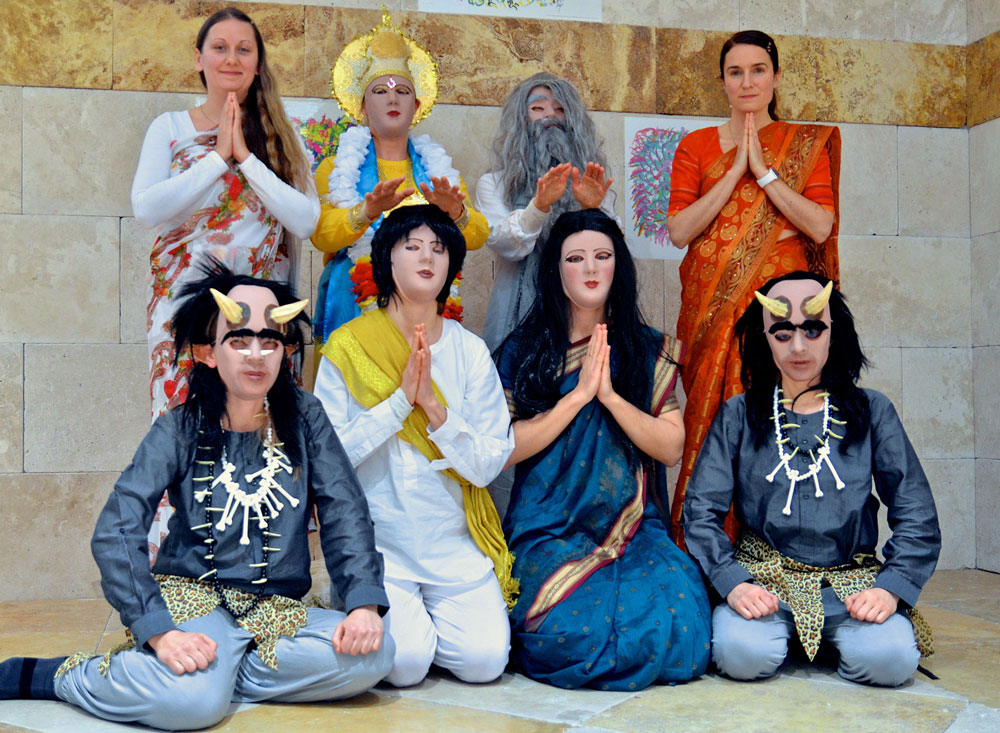
I rarely involved myself in plays up until then. I was – and still am – terrible at acting. My self-consciousness and inability to handle pressure led to a chaos of forgetfulness on stage. It saddened me not to contribute though, so that year in China I decided to take a risk and play to my strengths. I like to write. I could reliably read something out from paper. I could draw some faces on card, cut out holes for eyes, and tie them back as make-shift masks. The characters would mime, while others – including myself – would read their lines into a microphone off-stage. Hence everyone was hiding, which suited me well. The actors did not need to memorise their lines verbatim, which suited them too.
I was quite sure it would end in disaster even before it began, but to my surprise there were no accidents, even amongst the short-sighted, and any confusion was only a minor distraction. Sri Chinmoy was attentive, and I dare say even seemed quite pleased, which astonished me no end. So a new tradition began, and has continued beyond the Master’s passing, as the Sri Chinmoy Centre meets each year for Christmas Trips."
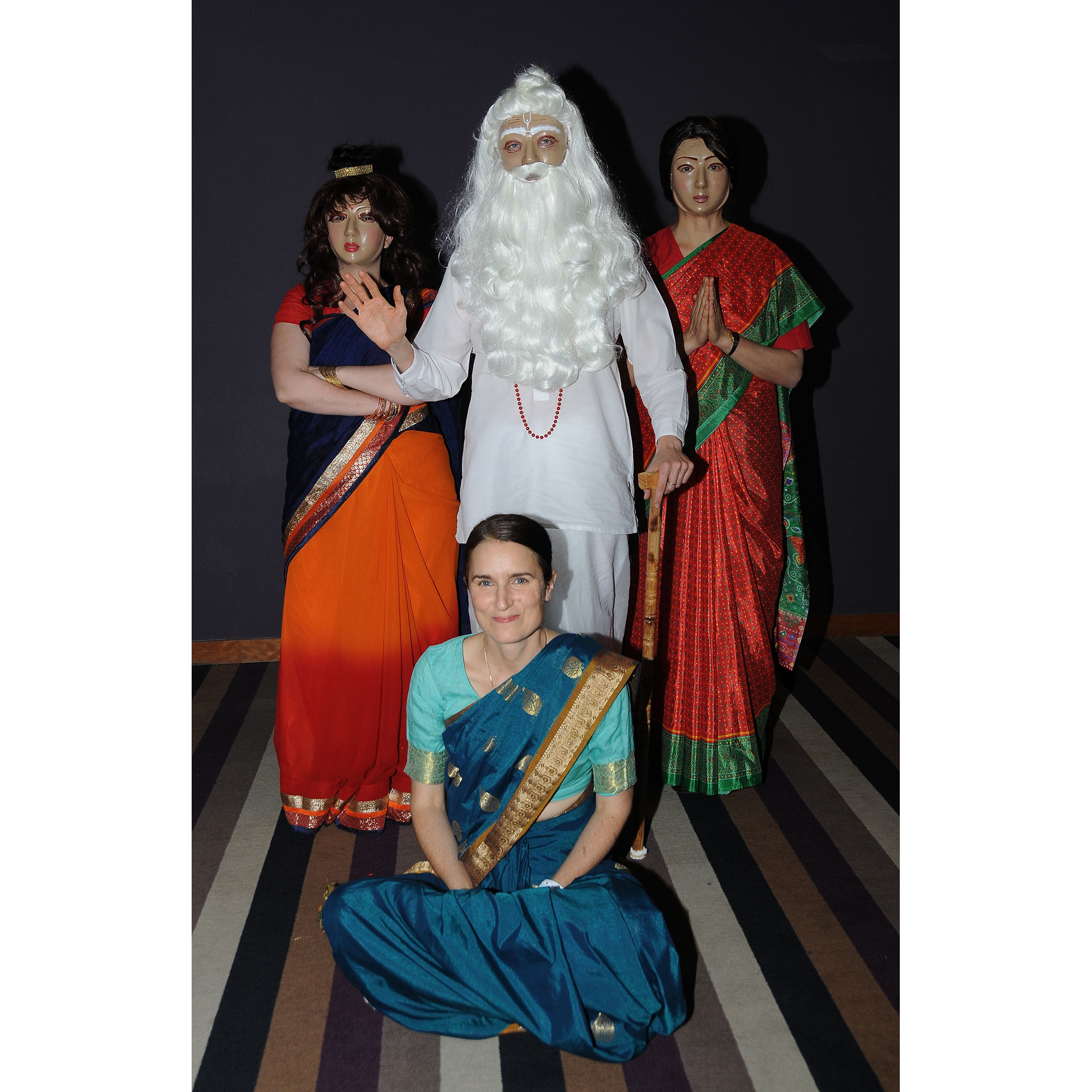
While striving to preserve the original teachings, the plays are embellished – often in a humorous way – and sometimes carry a modern interpretation.
As the actors mime behind masks while the poetry is recited off-stage, the plays perhaps combine two ancient spiritual traditions – rendering spiritual stories into verse, and masked performances.
The Ramayana, one of the great epics of the Hindu tradition, is known as the adi-kavya, or first poem. Great spiritual writings – for example, the Mahabharata and the Christian Bible – have been wrought into poetry through the ages, as an act of spiritual discipline and devotion. Sri Chinmoy himself set to verse the works of Sri Aurobindo, his own Guru - at the age of fifteen, he created 188 lines of Bengali verse from Sri Aurobindo's short story Ksharma Adarsha. In 1956 he translated it into 107 lines of English iambic pentameter verse. He set the Bengali poem to music in 2002, and it remains his longest song.
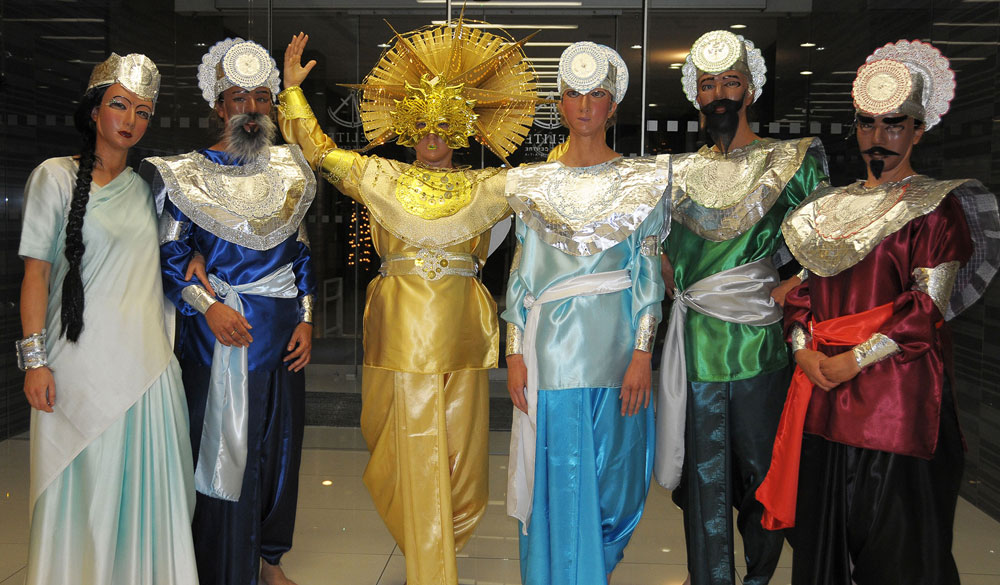
The use of masks in spiritual ceremonies dates back thousands of years, and later extended to various theatrical traditions throughout the world. In Asian countries such as India and Indonesia they are often used in elaborate performances of the Ramayana and Mahabharata. In the Middle East, folk theatre includes masked acting and puppetry, which has been a part of religious occasions for centuries. Actors in Ancient Greece wore masks, especially when depicting a powerful character such as a god. In Japan, Noh theatre evolved from more ancient forms of masked acting.
Related
- Books by Sri Chinmoy and students of Sri Chinmoy
- Auspicious Good Fortune by Sumangali Morhall
Book available for purchase
- Plays based on stories by Sri Chinmoy at Amazon
What brought me to the spiritual life
Paula Correia
Paula talks about what drew her Sri Chinmoy's spiritual path, and describes the lasting changes in her life as a result of practising meditation and following a spiritual life.
The spiritual value of running marathons
Sri Chinmoy encouraged running as a complement to meditation and the spiritual life. He saw how it could help people transcend themselves, both inwardly and outwardly. Running helps both our physical health, which is needed to meditate well, and also helps to bring forward qualities such as concentration, discipline and a quiet mind.
Running is a symbolic sport in the sense that it reminds us of spiritual seekers continuously running towards the goal; it resembles the seekers running inwardly to achieve the ultimate goal in meditation.
Sri Chinmoy
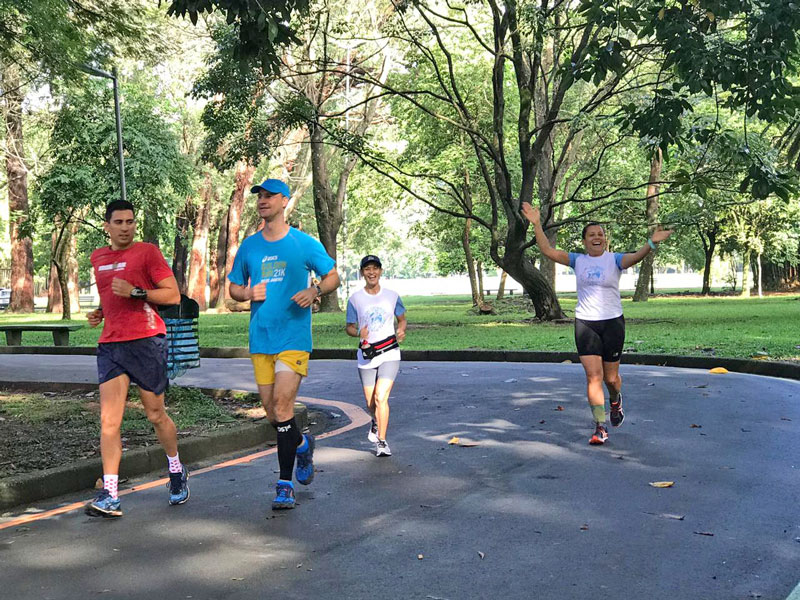
Many members of the Sri Chinmoy Centre run as part of their daily spiritual practice and often complete one or more marathons a year - the gold standard of distance running. They also organise marathons and other distance events for the general public as part of the Sri Chinmoy Marathon Team. Sri Chinmoy events are well known for creating a friendly atmosphere and seeking to maintain high standards of service to runners.
Sri Chinmoy himself took up long-distance running at the age of 47, showing that age need not be a barrier to running and physical fitness. He completed his first marathon on 3 March 1979 in Chico, California in a time of 4:31:34, and went on to do 21 more marathons and 5 ultras. This weekend, members of the Sri Chinmoy Centre around the world completed marathons to mark the 40th anniversary of Sri Chinmoy's first marathon run.
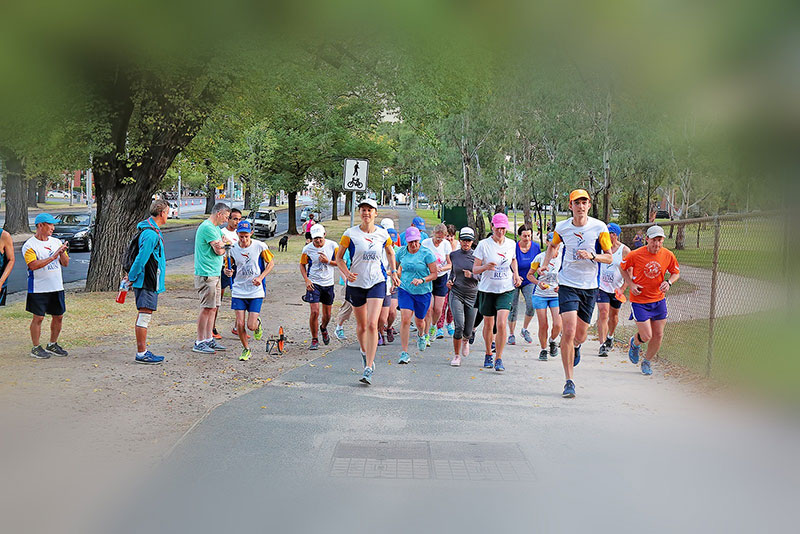
In Melbourne, Australia, around 50 students of Sri Chinmoy took part in a marathon event. They were joined by an international team of runners from the Sri Chinmoy Oneness-Home Peace Run who had recently run from Brisbane to Melbourne as part of a global torch relay which began in February and will run until November, visiting all the countries in the Southern Hemisphere along the way.
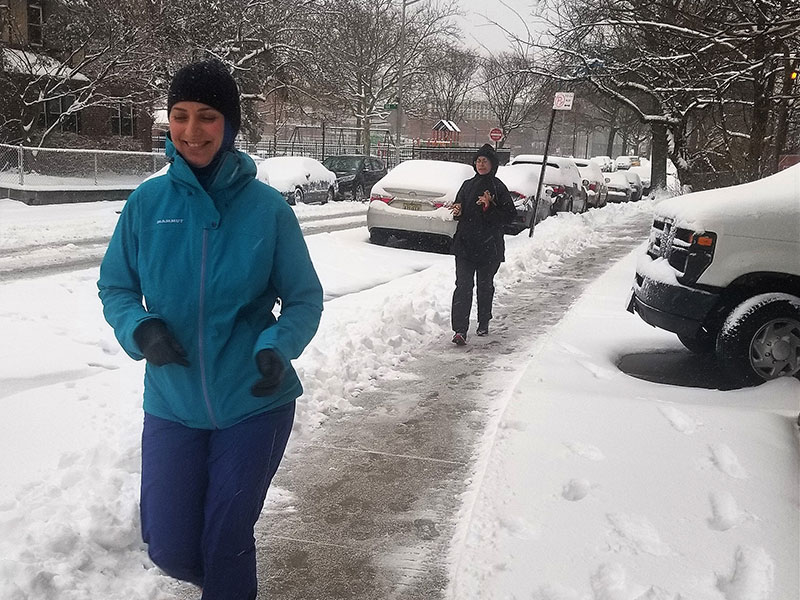
In Chico, California, 70 members of the Sri Chinmoy Centre took part in celebrations to mark the anniversary. The Chico marathon - called the Bidwell Classic - is still run as an event 40 years later, albeit over the half-marathon distance. Some runners then proceeded to do the half-marathon a second time to complete the full marathon distance.
In addition, marathon events were held by Sri Chinmoy Centres all over the world, including in Augsburg (Germany), Bristol (UK), Dublin (Ireland), Zlin (Czech Republic), New York (US), and Sao Paulo (Brazil)
Sri Chinmoy on marathons
Long-distance running gives us a real feeling of accomplishment. We can run 100 metres forty times during the year and not feel the same sense of accomplishment as when we run one marathon. But speed and endurance are both important, especially in the spiritual life. If one has only speed, then one cannot ultimately succeed; we need endurance because the goal is quite far. Again, if one has only stamina and no speed, then it will take forever to reach the goal. Only if someone has both qualities will he be able to make very good progress in his spiritual life and achieve something really great in life.
Sri Chinmoy
How running and meditation go together
More on our other sites
- Video: Samunnati on meditation and running - Samunnati Lehonkova is a marathon runner who took up running at an early age after becoming a disciple of Sri Chinmoy, and ended up competing in the Olympics in 2016.
- Seven Steps to a Successful Marathon Arpan DeAngelo has been a student of Sri Chinmoy since the early 1970s; he has completed over 300 marathons.
- Sri Chinmoy's Philosophy on Running - at the Sri Chinmoy Marathon Team website
Quotes by Sri Chinmoy are taken from his book The outer running and the inner running.
- ‹ previous
- 74 of 337
- next ›

Except where explicitly stated otherwise, the contents of this site are licensed under a Creative Commons Attribution-NonCommercial-NoDerivs 3.0 Unported License. read more »
SriChinmoyCentre.org is a Vasudeva Server project.